Showing posts with label Kalumbardo. Show all posts

11/25/25

Mahamat ibnou Dirmi and Wadai

Whilst perusing Abd el-Karim ibnou Djamé, propagateur de l'Islam et fondateur du royaume du Ouaddaï by Marie-José Tubiana, Issa Hassan Khayar, and Paule Deville, we noticed yet again the Borno/Kalumbardo connection for Wadai's founder. According to various oral traditions, Abd el-Karim studied theology or religion with a Mahamat ibnou Dirmi. This name appears in Muhammad Bello's account of the first Kalumbardo's destruction at the hands of Umar b. Idris of Borno. It also appears in Borno oral traditions and in Wadai. We have written about this elsewhere in our endeavor to analyze Umar b. Idris's decision. Yet the traditions cited by Tubiana et al. strengthen the Borno identification.  For example, the account of Adam Mahamat el-Amin of Wadai referred to Mahamat ibnou Dirmi in the following manner: "Il fut tué injustement par ses enemies"(27). Wadai tradition is adamant that Mahamat ibnou Dirmi was buried in Dar Bornou (20). 

Interestingly, however, Wadai tradition remembers a shaykh named Dede who was buried at the Bahr El-Ghazal (27). This is possible since Bagirmi (where Bidderi is located) in the late 1500s and early 1600s was not disconnected from this area and Islamic scholars sometimes taught in different locations as they moved. More importantly, if the teacher of Abd el-Karim was indeed the same leader of the first Kalumbardo, is it not unreasonable to postulate a totally political motive for the Borno mai's decision to execute him and exile Waldede? Consequently, does this mean that Wadai's foundations possibly preceded the reign of Umar b. Idris of Borno (r. 1619-1639, in Lange's chronology)? This could mean that Barth's chronology for the kings of Wadai is more accurate than that of Nachtigal's, although further confirmation is necessary. 

Tantalizing clues, however, may be found in the sparse data about one of the predecessors of Umar b. Idris. According to Palmer's Bornu Sahara and Sudan, Muhammad b. Idris (1596-1612) died in Kanem. According to Palmer, "He was slain in Holy War, and buried at Dagana Daniski" (244). This could have been related to the rise of Abd el-Karim's rise to power in Wadai. His political ascent led to some of the Tunjur leaving Kanem, although pressure on the Bulala sultans of Kanem may have also been a factor since it is unclear if a Tunjur exodus from Wadai had already begun in c.1610 or 1611. Either way, it does seem rather likely that Mahamat ibnou Dirmi was the very same leader at the first Kalumbardo. If one of his students, Abd el-Karim, later overthrew the Tunjur dynasty, it is no wonder that Umar b. Idris viewed Waldede and al-Jirmi as a political threat. 

9/23/25

The First Kalumbardo and Umar b. Idris

One of the mysteries of ulama-state relations is the tragedy of the first Kalumbardo settlement in Borno. The traditions and written sources on this shadowy event are unclear and, sometimes, contradictory. Nonetheless, it is clear that the Sayfawa ruler of Borno, Umar b. Idris (r. 1619-1639) ordered the execution of a prominent shaykh affiliated with the Kalumbardo settlement. In addition, another cleric associated with the settlement was forced into exile or pressured to flee to Bagirmi. Many unanswered questions persist about the nature of this conflict, the background of the central personages, and the connection between this first Kalumbardo community and the second one led by a Koyam shaykh. This post will explore the dimensions of the first Kalumbardo community's conflict with mai Umar b. Idris and possible relevant factors for its dissolution. 

First, the major source. Muhammad Bello, whose Infaq al-maysur was written in the early 1800s, praised the shaykhs associated with the first Kalumbardo settlement as scholars promoting Sufism. However, his language is rather uncertain about many of the details, implying that he relied on tradition for most of his narrative. In addition, he may have inserted a falsified speech by one of the victims of Umar b. Idris, Shaykh Waldede. In this speech, Waldede hints at the fall of Borno when a renewer of the faith appears, perhaps represented by Uthman dan Fodio (Bello 71). As a result of this problematic speech inserted into the narrative and the fact that Bello was writing a work that sought to justify the jihad and the Sokoto Caliphate, it is possible some elements of the narrative are embellished or exaggerated to heighten the unjust, corrupt, and immoral nature of Sayfawa rule. These issues aside, other sources and traditions recall Shaykh Waldede's conflict with the ruler of Borno. Moreover, the Sufi leader executed by the state, Shaykh al-Wali b. al-Jarmi, appears in other traditions. Bello identifies the latter as a Tuareg (71). In addition, Waldede was said to have studied in Agadez and Timbuktu (71). If true, then the identification of al-Jarmi as a Tuareg could also be valid. Bello's retelling of events could support the narrative of Waldede studying in the west and then returning to Borno with a Tuareg Sufi, collaborating in the leadership of a zawiya which threatened the state. This threat to the state presumably led to divisions among the ulama  in the Sayfawa court.

But, some elements of Bello's account are problematic. According to him, Waldede died a little after 1000 A.H. (71). If this is true, then Waldede died before the reign of Umar b. Idris. As previously mentioned, Bello was also writing a larger work that sought to justify the Sokoto Caliphate. In other words, the oppressive, unethical, or non-Islamic traits of previous governments in the region were emphasized, even in the case of Borno where Islam was deeply rooted. Additional problems with this narrative can be seen in oral traditions which identify the Borno king who exiled Waldede as Ibrahim (Lavers 223). Hammidu Bobboyi, relying on oral traditions, identifies al-Jarmi as a Borno native of Arab origin. In fact, there was a Shaykh Jirmi (spelling of Bobboyi), son of Goni Salih. This Shaykh also had two sons, Hassan and Musa Dangul (Bobboyi 17). On the other hand, H.T. Norris, whose Sufi Mystics of the Niger Desert sees the influence of the Mahmudiyya of Air in Kalumbardo, argued in favor of a Tuareg origin for al-Jarmi. According to him, al-Jarmiyu's name indicated Tuareg origin. Furthermore, in Borno folklore, Waldede was said to have escaped the horsemen of Umar b. Idris on a flying blanket (36). This contradicts Bello, whose narrative suggests that Umar b. Idris let Waldede go after executing al-Jarmi. Last but certainly not least, Bello attributes Umar b. Idris's brutal crackdown to secular reasons. Oral traditions in Borno, suggest theological differences related to tawhid (100). Muhammad Nur Alkali cites divisiveness caused by the Sufism of al-Jarmi and Waldede (Nur Alkali 256). 

So, how can one reconcile these traditions? The fact that apparently disparate traditions from Borno, the Sokoto Caliphate, Bagirmi, and Wadai seem to refer to the conflict between a ruler of Borno and the leadership of the first Kalumbardo attest to its historicity. Sources from Wadai, for instance, recall that the founder of the sultanate, Abd al-Karim, studied at Bidderi (Barth 528-529). His teacher, identified by Barth as Muhammad and as Mahammat el-Djirmi in a text published by Tubiana are probably the same al-Jirmi of the first Kalumbardo (Tubiana 58). Borno tradition recalls both Waldede and al-Jirmi, with one variant recorded by Palmer identifying the mai who sent a kaigama against "Umar dan Didi" as Dunama Dibalemi (Lavers 223). The connection to Bidderi for the founder of the Wadai Sultanate is still plausible, as the Waldede family were likely linked to its Fulani residents. Consequently, it is feasible that al-Jarmi (or a member of the family) taught at Bidderi before returning to Borno. Such a link connects the first Kalumbardo to both Bidderi in Bagirmi and with the origins of the first sultan of Wadai to the east.

To better comprehend the possible roots of the conflict, one must retrace their steps and ponder the recent past and larger context of Kalumbardo. Beginning with Bagirmi, Nachtigal's history of the reign of Abdallah (c.1568-1608) suggests growing royal patronage of Islam. Indeed, 4 mu'allim of Fulani origin, who are named Dede, Shille, Aji Amede, and Majangala, are said to have helped design the ground plan for his palace. They were also sent to different villages around the kingdom to teach and spread Islam. Nachtigal also tells us this ruler appointed a qadi, an imam, established mosques, invited foreign clerics, and therefore thoroughly promoted Islam (Nachtigal 403). If the chronology for Abdallah's reign is accurate, this suggests that Bidderi in the late 16th century and early 17th century likely benefited from state patronage. Indeed, the Fulani were established in the area north of Ba Batshikam by the 1400s, when they paid tribute to the Bulala rulers of Kanem (398). When the state of Bagirmi was founded in the early 1500s, the Fulani were remembered as allies of the newcomers who established the state (400). This suggests that Bidderi and similar settlements of Fulani Muslims may have welcomed students from other communities whilst also participating in broader regional centers of learning in Borno or beyond. Therefore, traditions of Wadai's founder studying in Bidderi before seizing power in the early 17th century are plausible. Moreover, if al-Jarmi was present in Bidderi or Bagirmi, it could be due to Waldede already having links there since the late 16th century. 

If, however, one accepts the Agadez and Timbuktu travels of Waldede as plausible, then one must also look closely at the Air region's history. In this region, the Mahmudiyya Sufis were established in the 1500s. Their disciples also included a prominent Fulani, Ahmad b. faqih Awgar al-Fullani (Norris 42). It is difficult to imagine that a Fulani scholar with ties to other Islamic Fulani communities did not encounter followers of Sidi Mahmud al-Baghdadi. Other events in Agadez or Air during this period include a revolt led by Hadahada during the reign of Muhammad al-Tafrij. This revolt, which Hadahada led as a jihad against the sultanate, lacks a precise date. Nonetheless, this sultan's reign overlapped with that of Umar b. Idris (Hamani 230). In this environment, with a Sufist leader killed by a sultan in the 1500s and then a revolt against the Sultan challenging his legitimacy on Islamic grounds, one might imagine the intellectual climate Waldede (and al-Jarmi?) experienced or at least were influenced by.

From Borno's perspective, the early decades of the 17th century required active leadership and policy to maintain the sultanate's status as a regional power. Yet the Tuareg of Air remained a persistent thorn. Nur Alkali attributes to Ibrahim b. Idris several campaigns against them (Nur Alkali 255). Oral traditions point to the reign of Umar b. Idris for the establishment of a Mandara prince in Muniyo. This prince, Kazelma Saemi, was sent explicitly to aid the Gamagama in their fight against the Tuareg (Landeroin 404). Umar b. Idris even sponsored the creation of the galadima at Nguru to defend Borno's western frontier, appointing his son by a slave woman to the post. The first galadima already had to put down a Fulani revolt (Palmer Gazetteer 104). These measures taken by Umar b. Idris imply concern for the border was central to state interest, especially to the west. This suggests that the strategy of Idris Alooma to rely on the Koyam and other local populations to make constant raids against the Tuareg, as well as to secure the loyalty of some of them to Borno instead of Agadez, did not succeed. When one also considers the chances that Umar b. Idris was also an elderly man when he took the throne, and perhaps his brother Ibrahim b. Idris was assassinated, concern for state security and political stability must have been paramount (Palmer BSS 98). According to Nur Alkali, he was also known for not accepting any opposition (Nur Alkali 256). This may also explain why Umar b. Idris chose to have al-Tahir of the Awlad Muhammad dynasty drowned when the latter fled to Borno from the Fazzan in 1622/3 (El-Hesnawi 114). Umar, who may have viewed the nephews of al-Tahir as the legitimate rulers of the Fazzan, wanted to punish al-Tahir for usurping the throne from them. Otherwise, Umar b. Idris also viewed the matter as another entanglement that threatened the status quo among powers in the Central Sudan/Sahara. 

Given what we know of Umar b. Idris's background, the first Kalumbardo community triggered his concern for protecting the state. Norris, whose study of the Mahmudiyya in Air was heavily based on the Qudwa, believes that the "Way" promoted by Waldede and al-Jarmi was influenced by Sidi Mahmud al-Baghdadi. Thus, Umar b. Idris acted in the way he did due to the proximity of the Kalumbardo leadership with Air (137). Norris's hypothesis is an attractive one, but lacks enough evidence of the actual practices of the Waldede and al-Jarmi to validate it. Their practices may have been similar to the Sufi practices of al-Baghdadi's followers, but without sources to describe what they actually did, it remains a hypothesis. However, the fact that the sultan of Agadez during Umar b. Idris's reign also had to put down Hadahada's revolt may have been another factor in the Sayfawa ruler's decisions. If Hadahada's revolt occurred before the Kalumbardo leaders were called to the court, perhaps Umar b. Idris acted harshly due to a fear that Waldede and al-Jarmi would lead a revolt like Hadahada? Ultimately, a clear link between the two region's Sufi centers at this time is ambiguous, but the traveler al-Yamani, who visited both the second Kalumbardo community and Air, visited Ahmad al-Targui al-Lamtouni in Air (Nashr al-Mathani 308). 

If the Sufism promoted by Waldede and al-Jarmi was the trigger for Umar b. Idris's exiling the former and killing the latter, one must closely examine how the state and Islamic scholars and holy men interacted at this time. Since Sufism in Borno predated the first Kalumbardo settlement, and many rulers, including Umar b. Idris, had performed the pilgrimage to Mecca or spent time in Egypt, we find it difficult to believe the "oriental mysticism" exemplified by the Mahmudiyya would have been very novel or shocking. Besides, the Krump witnessing Muslims from Borno and the Fazzan engaging in what sounds like Sufist practices with music, dance and ritual prayer suggest Islamic mysticism likely had deeper roots in the region, possibly before the first Kalumbardo community. 

Another perspective on the issue focuses on theology. In Bobboyi's view, the debate over theology rather than Sufism itself caused the conflict (Bobboyi 100). As a result, the garbled traditions recall al-Jirmi was killed on the grounds of a fatwa he issued. The tradition asserts the shaykh gave a fatwa accusing another of being an unbeliever. Then, on the same grounds, the Sayfawa court declared al-Jirmi an unbeliever and executed him (101). Further, it may have involved Quranic folios in his shoes to declare him a kafir (112). This may be why, in Muhammad Bello's version of the execution, the Shahada was miraculously written in his blood (Norris 133). This could be, through the use of a miracle, Muhammad Bello's allusion to the accusation of unbelief. Even if it wasn't the Sufist practices of the community that led to the fatal confrontation with Umar b. Idris, the latter's actions were not met with universal support. Nur Alkali, citing Sheriff Ibrahim, writes of some of al-Jarmiyu's disciples leaving Birni Gazargamo because of Umar b. Idris's actions (259). Thus, the mai did something that was, to some at least, controversial and immoral. It was certainly remembered as such in Bagirmi and Wadai. 

After revisiting the sources on the Waldede-Jirmi affair, many questions remain unresolved. Why is it that the second Kalumbardo community, led by a charismatic shaykh who was accused by a qadi tied to the court of Ali b. Umar, allowed to continue his zawiya? Abu Bakr, the qadi, pressured Ali b. Umar into opposing the shaykh on the grounds he was a threat to the throne. Yet, unlike his father, who executed al-Jirmi, Ali b. Umar recognized his saintliness and supported the settlement. Like his father, he too had performed the pilgrimage and was certainly aware of various Sufi brotherhoods in the Muslim East. Was his acceptance of the mission predicated on coopting it through state support, brick workers for a mosque, and a close relationship with the state to neutralize any threat it might pose? Borno during his reign still had the challenge of Tuareg raids, and the second Kalumbardo community's leader was even killed by Tuareg raiders. If the Kalumbardo community's practices were so similar to those of Sufis in Air, why was the mai not worried about them? Or, was the mai eager to support the Kalumbardo shaykh for the spiritual and Islamic legitimacy it endowed his regime with? Ali b. Umar was known for his support of Islamic learning, his piety, and the projection of Borno as an Islamic state. Affirming it through a vibrant Sufi community on Borno's frontier may have served to support this image of the state. 

In summation, our knowledge of the first Kalumbardo settlement and the reign of Umar b. Idris raises more questions than answers. This mai seems to have been especially concerned with protecting his power and Borno's borders. While the leaders of this community were likely linked to the spread of Islam in Bagirmi and Wadai, the ruler of Borno saw that it was paramount to maintain his power and protect the state from any rebellion, assassination, or division. When some of the ulama of his court were drawn to the first Kalumbardo's Sufist practices, Umar b. Idris responded in a way that immediately minimized the threat. That the community was reborn under Koyam leadership during the reign of his son also raises questions. Possibly by the reign of Ali b. Umar, we see here a more concerted effort to accumulate baraka and Islamic legitimacy through state sponsorship and cooptation of renowned shaykhs.

Bibliography

Alkali, Mohammad Nur. 2013. Kanem-Borno under the Sayfawa: A Study of the Origin, Growth, and Collapse of a Dynasty (891-1846) . Nigeria: University of Maiduguri.

Barth, Heinrich. Travels and Discoveries in North and Central Africa: Being a Journal of an Expedition Undertaken Under the Auspices of H.B.M.'s Government in the Years 1849-1855. New York: D. Appleton, 1857.

Bello, Muhammad and Salahudeen Yusuf (editor). A History of Islam, Scholarship and Revivalism in Western Sudan, Being an Annotated Translation with Introduction of Infaqul-Maisur Fi Tarikh Bilad al-Tukur of Sultan Muhammad Bello Bin Fodio  / Salahudeen Yusuf. Zaria, Nigeria: Tamaza.

Bobboyi, Hamidu. The ’Ulama of Borno : A Study of the Relations between Scholars and State under the Sayfawa, 1470-1808. Dissertation, 1992.

Brenner, Louis. The Shehus of Kukawa: A History of the Al-Kanemi Dynasty of Bornu. Oxford: Clarendon Press, 1973.

Dewière, Rémi. Du Lac Tchad à La Mecque: Le Sultanat Du Borno Et Son Monde (XVIe - XVIIe Siècle). Paris: Publications de la Sorbonne, 2017.

Hamani, Djibo. Au Carrefour Du Soudan Et De La Berbérie: Le Sultanat Touareg De L'Ayar. Niamey: Institut de recherches en sciences humaines, 1989.

Hassan, Yūsuf Fadl, and Paul Doornbos (editors). 1979. The Central Bilād Al-Sūdān : Tradition and Adaptation : Essays on the Geography and Economic and Political History of the Sudanic Belt : Proceedings of the Third International Conference of the Institute of African and Asian Studies, University of Khartoum, Held from 8 to 13 November 1977. Khartoum: The Institute.

Al-Hesnawi, H. W. Fazzan under the rule of the Awlad Muhammad. A Study in political, economic, social and intellectual history. Dissertation, 1990.

Lange, Dierk. Le Dīwān Des Sultans Du (Kānem-)Bornū: Chronologie Et Histoire D'un Royaume Africain (de La Fin Du Xe Siècle Jusqu'à 1808). Wiesbaden: F. Steiner, 1977.

__________.  A Sudanic Chronicle: The Borno Expeditions of Idrīs Alauma (1564-1576) According to the Account of Aḥmad B. Furṭū : Arabic Text, English Translation, Commentary and Geographical Gazetteer. Stuttgart: F. Steiner, 1987.

Nachtigal, Gustav, Allan G. B. Fisher, and Humphrey J (trans.). Fisher. Sahara and Sudan, Vol. II. Berkeley and ; Los Angeles: University of California Press, 1971.

Norris, H. T. 1990. Ṣūfī Mystics of the Niger Desert : Sīdī Maḥmūd and the Hermits of Aïr. Oxford England: Clarendon Press.

Palmer, H.R. Gazetteer of Bornu Province.  Lagos: Govt. Printer, 1929.

___________. The Bornu Sahara and Sudan. London: J. Murray, 1936.

___________. Sudanese Memoirs: Being Mainly Translations of a Number of Arabic Manuscripts Relating to the Central and Western Sudan. 1st ed., new impression. London: Cass, 1967.

Al-Qâdirî, Mouhammad, Michaux-Bellaire, Édouard (trad.), Nachr al-Mathânî, II, De l’an 1051 (1641J.-C.) à l’an 1100 (1688 J.-C.). Paris: Ernest Leroux (Archives marocaines, vol. XXIV), 1917.

Tilho, Jean (editor). Documents Scientifiques De La Mission Tilho. Paris: Imprimerie Nationale, 1910.

Tubiana Marie-José. "Un document inédit sur les sultans du Waddāy." Cahiers d'études africaines, vol. 1, n°2, 1960. pp. 49-112. DOI : https://doi.org/10.3406/cea.1960.3667

Usman, Yusufu Bala, and Nur Alkali (editors). 1983. Studies in the History of Pre-Colonial Borno. Zaria: Northern Nigerian Pub. Co.

Zakari, Maïkorema. Contribution à L'histoire Des Populations De Sud-Est Nigérien: Le Cas Du Mangari (XVIe-XIXe S.). Niamey: Institut de recherches en sciences humaines, 1985.

5/11/24

Sheikhs of the Koyam and the Legacy of Kalumbardo

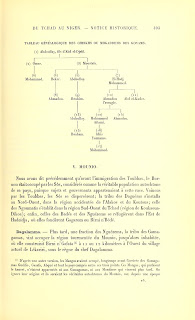
Family Tree of Koyam Shaykhs


Nestled in the northwestern borderlands of the Borno state, near the edges of the Sahara and the caravan routes connecting the Central Sudan to North Africa and the Nile Valley, the Koyam were a pastoralist sub-group of the Kanuri whose reputation for Islamic learning outlasted the dynasty they served. Their settlement at Kalumbardo — and later Gaskeru — became one of the most remarkable centers of Sufi practice in precolonial West Africa.  Although the community was important enough to contribute to the origin of the Zinder state's ruling dynasty as well as to the spread of Sufi and Islamic practices across Borno and, perhaps, Wadai and Bagirmi, we unfortunately know too little of the community's history. Besides the oral traditions collected by Landeroin at the beginning of the 20th century and occasional references to Kalumbardo's widely respected shaykh in the 17th century in Maghribi sources, a comprehensive history of the community remains undone. Fortunately, what can be gleaned from the history of Sidi al-Baghdadi's movement in the Air desert plus other references to Sufism and asceticism in Kanem-Borno and Sudanic Africa, sheds some light on the history of the Kalumbardo community.

First, its shadowy origins. Muhammad Bello described a community called Kalumbardo that was in existence by the time of Umar b. Idris, mai of Borno in the years 1619-1639. Of course, this was not the first center of Sufism in Borno and certainly not the first mallamti or community or fief recognized by the mai's of the Sayfawa. Indeed, according to Rémi Dewière, Sufism of the Shadilya sect was practiced in Borno before the 17th century. Evidence of this was detected in his study of Ahmad b. Furtu's chronicles of mai Idris b. Ali. Indeed, practices close to those of al-Sadili as well as earlier references to ascetics in Kanem during the 14th century point to likely Sufism in Borno long before the 1600s. However, the history of Kalumbardo is a better documented history of a community defined, in part, by Sufist practices or influences. 
 
According to Muhammad Bello of the Sokoto Caliphate, this first Kalumbardo community was led by a Shaykh Waldeed and al-Waliyy b. al-Jarmi, a Tuareg. The two leaders, Fulani and Tuareg respectively, were said to have spread Sufism, and the former allegedly had studied in Agadez and Timbuktu. This suggests that the original Kalumbardo community was led by two reputable Sufis with links to Agadez and Timbuktu, prominent centers for Islamic scholarship that had been under Songhay control in the 1500s. Moreover, according to Bello's account, Umar b. Idris had al-Jarmi executed while Waldeel fled to Baghiri. This account of the mai's crackdown on the first Kalumbardo community sounds very similar to Bello's recounting of the end of Shaykh al-Baghdadi in Air. Said to have been killed by the sultan of Agadez at Aghalanga, the conflict was instigated by court-affiliated scholars who urged the sultan to target Shaykh al-Baghdadi. Thus, we may have something of a common literary trope in which a venerated Islamic holyman is martyred by a secular ruler whose court-aligned ulama see in the holyman a threat to their own status and the power of the sultan. Of course, in the case of al-Baghdadi in Air, his status as a sharif added another layer of threat. 

John Lavers, in his article "Diversions on a Journey of the Travels of Shaykh Ahmad al-Yamani," adds further detail to the history of this earlier Kalumbardo. According to him, some traditions remember the Tuareg leader of the first Kalumbardo as al-Jarmiya al-Tarqi as a teacher of Abd al-Karim b. Jame, the first sultan of Wadai. While other traditions claim Wadai's founder had studied at Bidderi in Baghirmi, this location in the Baghirmi kingdom was a settlement associated with the Torobbe Fulani and Islamic scholarship. However, it does not necessarily contradict the other tradition associating Wadai's founder with the Tuareg at the first Kalumbardo. After all, the Shaykh Waldeel of Muhammad Bello was said to have escaped Borno for Baghirmi. Thus, this early Kalumbardo community, which probably arose before the reign of Umar b. Idris, enjoyed or later extended itself through its persecution, far links to Agadez, Timbuktu, Bagirmi and Wadai. And to make things even more confusing, it is possible that, according to traditions cited by Lavers, it was Ibrahim b. Idris, a brother who reigned as mai before Umar b. Idris, who had been responsible for destroying the first Kalumbardo community.

What occurred after the dissolution of the first Kalumbardo community, which appears to have lacked the ethnic Koyam affiliation or identification of the second Kalumbardo? We know that, by the 1660s, during the reign of Ali b. Umar of Borno, Kalumbardo was again associated with a venerated Shaykh whose piety, scholarship, and asceticism led to his reputation reaching Sinnar and North Africa. He was Shaykh Abdullay al-Barnawi, or Abdullay b. Abd el-Djelil. According to Bobboyi, he was a scion of the Sayfawa dynasty and the first Shaykh of the re-formed Kalumbardo town or settlement, also called Belbelec. While it is said that many mothers of Sayfawa rulers were women from the Koyam, and the Koyam reputation for Islamic scholarship was still respected in the 19th century since Shehu al-Kanemi had apparently studied with them, the exact origins of the Koyam's presence in the northwestern borderlands of the Borno state remain unclear. Indeed, Lovejoy's Salt of the Desert Sun suggests Kawar origins of the Koyam, perhaps indicating the early Sayfawa dynasty's northern alliances with nomadic populations in medieval times through marriage alliances with women from their clans. This appears to be true, if the Koyam are indeed the same as the Kay mentioned in the Diwan and their links to Kawar and the salt trade suggest their economic importance in Borno. Nonetheless, in the traditions and sources cited by Maikorema Zakari, this Abdullah founded the second Kalumbardo with 40 Koyam during the reign of Ali b. Umar (a mai famous for his piety and support for Islamic scholarship). While the Koyam, a pastoralist sub-group of the Kanuri later split into the Kel Etti and other branches, in the 17th century, under Shaykh al-Barnawi, this particular Koyam community enjoyed great repute. Indeed, the first Shaykh, said to have been born in 1614, was associated with miracles, great learning, and even attempts at social reform with Tuareg and Tubu bandits in the area. This Kalumbardo shaykh was credited with converting many non-Muslims, marrying slave girls and then giving them (with his children by them) to Tuareg and Tubu, and promoting Islamic asceticism among his followers. 

But who was this Abdallah al-Barnawi? According to the Nashr al-Mathani, ultimately relying on the account of Kalumbardo given by Ahmad al-Yamani of Arbaji, al-Barnawi enjoyed mystical powers. He was a man said to have been light in color, tall, possessing middle build and had large eyes. He took a vow of poverty and members of his community often pursued separate areas for retreat, or khalwa. They regrouped for communal prayers and chanting. Shaykh al-Barnawi also appeared to have been a fervent believer in the ability of people to change and respect for life. After all, the same North African source, Nashr al-Mathani includes a brief anecdote of al-Barnawi's anger when a disciple prayed for God to destroy the Tuareg. In addition to his embrace of prayer and meditation, al-Barnawi also possessed a thorough knowledge of the Koran, grammar, theology, and other texts. He was said to have read the Alfiya of Ibn Malik on grammar and may have even studied in modern-day Sudan with Dafa 'Allah of Arbaji. If true, this may explain one of the reasons al-Yamani of Arbaji traveled to Kalumbardo in 1671, because its leader had been known in the Funj Sultanate. If so, this suggests far-reaching networks of Islamic scholarship, Sufist practices, and mutual influences between Borno and the Funj Sultanate. Perhaps the Islamization of Wadai and Darfur in the 17th century facilitated this process, as a trade and pilgrimage route that traversed Sudanic Africa was likely of growing importance in this era. In fact, Nashr al-Mathani also mentioned al-Yamani's travels to Air, where he studied under Ahmad al-Targui al-Lamtouni. Similarly, Norris's Sufi Mystics of the Niger Desert also claimed al-Barnawi had studied in or near Agadez with Uwayis, just as Lavers argued that the Tuareg Ahmad as-Sadiq b. Ab. Muhammad Uways had traveled to Arbaji. These far-flung networks connected Borno's Kalumbardo with Air, the Sinnar Sultanate, and North Africa. In this light, it is perhaps of interest that the ascetic practices described by Sufis in Air, the Sinnar Sultanate, and Borno would be interesting to compare, particularly with regards to the khalwa, wird, the role of music, group meditation, fasting, the presence of spirits and beliefs about the sanctity of animal lives.

What was the fate of the second Kalumbardo community? Its shaykh, Abdullah al-Barnawi, was killed by the Tuareg in an attack that occurred in 1677 or 1678. Before the demise of its leader, the community received support from the mai of Borno. According to Lavers, a qadi named Abu Bakr went to Ali b. Umar, claiming the Kalumbardo leader was plotting a revolt. The shaykh was called to Birni Gazargamo, impressed the mai and then received support as the mai sent artisans to erect brick buildings in his settlement. This must have been part of the town's rise as it received exemption from taxes (which was likely recognized in writing via a mahram, recognizing the community's tax-exempt status) and attracted students, farmers, hunters, traders, and others. If the traditions collected in the Tilho Mission are reliable, Belbelec developed into a town of great extent. Unfortunately, its good fortunes were not to last. Famines and Tuareg attacks culminated in one raid by the Immikitan Tuareg that resulted in the death of the shaykh. Nonetheless, the town would relocate and prosper in Gaskeru, after al-Barnawi's son, Umar, led the community to as far away as Nupe. It was during this era of dispersal after 1678 that one person from the community, remembered as Mallam in the traditions, chose to settle in the area of Zinder or Damagaram and became its first sultan.  

The dispersed Kalumbardo community, led by Umar, eventually returned to Borno, staying at the capital until the mai (a son of Ali b. Umar?) granted Umar's community tax-exempt status at Gaskeru. At Gaskeru, the mai allegedly sent 1000 workers for the construction of a mosque and Gaskeru. And, according to the traditions collected for the Tilho Mission, Shaykh Umar reigned with justice, not oppressing the population. In this regard, one can see shaykh Umar's power as, per Lavers, a theocratic state within Borno that attracted residents through its just ruler and, perhaps, tax-exempt status. Successive shaykhs of the Koyam at Gaskeru began to claim a more political role, appointing disciples as chiefs or imams of areas under their control. The same aforementioned traditions claim the area controlled by the Koyam shaykhs even had 1000 villages under its control. This suggests that the community at Gaskeru became akin to some of the so-called fiefdoms discussed in the works of Muhammad Nur Alkali and Ronald Cohen on Borno land tenure and administration. Bakr, or Beker in the French Tilho Mission rendering, a son of Shaykh Mustapha, is remembered as having more loyal supporters than Mai Ali b. al-Hajj Dunama of Borno, whose soldiers abandoned him and let him become wounded in the 1781 invasion of Mandara. Unlike the mai, the Koyam shaykh, who did not personally arm and supply his 1000 followers, was said to have been complimented by the Sayfawa sultan for his devoted followers.

The latter days of Sayfawa rule did lead to troubled times for the Koyam shaykhs, however. Abdullah, the brother of Bakr, faced the Tuareg of Kutus and the Air Tuareg. With the help of the kaigama, Ali, they were able to push the Tuareg back but their forces were massacred when they pushed into Tuareg territory. Then, under Shaykh Ahmadu, the son of Bakr, Gaskeru was attacked and destroyed by the Tuareg. Ahmadu then led the community to Birni Gazargamo, to the Sandaram quarter. Under Shaykh Ibrahim b. Abdullah, they refused to return to Gaskeru and were settled at Zigaba. Another dispersal took place after Goni Mokhar attacked Gazargamo, leading to the flight of the Koyam and Mohammad Aitami becoming the shaykh. Later, after al-Kanemi became the effective ruler of Borno, he acknowledged Muhammad Aitami's tax-free status. This shaykh eventually died in 1835, after which another split among the Koyams and then another reunion under Shaykh Yamiama at Biskour.

While the two centuries or so of history of the Koyam is sadly not as documented as the period under its first shaykh, the traditions and other historical references do provide a fascinating overview of a Borno Islamic community linked to Islamic asceticism. By the end of the precolonial era, only a small subset of the Koyam population preserved the ascetic practices of chanting, spiritual retreats and fasting. Nonetheless, its survival over the centuries and its link to other parts of Africa attest to its importance. Not solely as a center for Borno Sufis and as a group who helped protect Borno's northern borders from Tuareg incursions, but as a group which influenced important figures in the annals of Borno's political history, like al-Kanemi, but also contributed to the rise of Wadai and Damagaram. Lastly, the first shaykh, with links to North Africa, Air, and Funj Sultanate, was esteemed enough to be widely venerated across much of Islamic Africa. One only wishes that al-Barnawi or one of his followers had written a text, like the Qudwa, that could tell us in more detail the practices and ideas of such a prominent figure in Borno's history. For instance, did al-Barnawi's community also believe in the presence of spirits in their prayer circles or gatherings? To what extent was al-Baghdadi's movement a model or influence? And were Sufi practices and fuqara villages in the Funj Sultanate, observed by Krump, perhaps similar spaces with some degree of overlap in belief and practice with Kalumbardo and Gaskeru?

Bibliography

Bobboyi, Hamidu. 1992. The ’Ulama of Borno : A Study of the Relations between Scholars and State under the Sayfawa, 1470-1808. Dissertation.

Brenner, Louis. The Shehus of Kukawa: A History of the Al-Kanemi Dynasty of Bornu. Oxford: Clarendon Press, 1973.

Dewière, Rémi. Du Lac Tchad à La Mecque: Le Sultanat Du Borno Et Son Monde (XVIe - XVIIe Siècle). Paris: Publications de la Sorbonne, 2017.

Hassan, Yūsuf Fadl, and Paul Doornbos (editors). 1979. The Central Bilād Al-Sūdān : Tradition and Adaptation : Essays on the Geography and Economic and Political History of the Sudanic Belt : Proceedings of the Third International Conference of the Institute of African and Asian Studies, University of Khartoum, Held from 8 to 13 November 1977. Khartoum: The Institute.

Lange, Dierk. Le Dīwān Des Sultans Du (Kānem-)Bornū: Chronologie Et Histoire D'un Royaume Africain (de La Fin Du Xe Siècle Jusqu'à 1808). Wiesbaden: F. Steiner, 1977.

Lovejoy, Paul E. Salt of the Desert Sun: A History of Salt Production and Trade in the Central Sudan. Cambridge [Cambridgeshire] ; New York: Cambridge University Press, 1986.

Mission Tilho. Documents Scientifiques De La Mission Tilho. Paris: Imprimerie Nationale, 1910.

Norris, H. T. 1990. Ṣūfī Mystics of the Niger Desert : Sīdī Maḥmūd and the Hermits of Aïr. Oxford England: Clarendon Press.

Usman, Yusufu Bala, and Nur Alkali (editors). 1983. Studies in the History of Pre-Colonial Borno. Zaria: Northern Nigerian Pub. Co.

Vikør, Knut S.The Oasis of Salt: The History of Kawar, a Saharan Centre of Salt Production. Bergen, Norway: Centre for Middle Eastern and Islamic Studies, 1999.

Yusuf, Salahudeen, and Muḥammad Bello. 2013. A History of Islam, Scholarship and Revivalism in Western Sudan, Being an Annotated Translation with Introduction of Infaqul-Maisur Fi Tarikh Bilad al-Tukur of Sultan Muhammad Bello Bin Fodio  / Salahudeen Yusuf. Zaria, Nigeria: Tamaza.

Zakari, Maïkorema. Contribution à L'histoire Des Populations De Sud-Est Nigérien: Le Cas Du Mangari (XVIe-XIXe S.). Niamey: Institut de recherches en sciences humaines, 1985.