5/31/23

Solomonic Rulers, Sayfa Ar'ad


Tarik Amba is one of the better podcasts on Ethiopian history. Sadly, it has not been updated frequently. For our purposes, we wanted to share an episode on some of the Solomonic rulers in the medieval era. One of them, Sayfa Ar'ad, or Seife Ared, became a character representing Ethiopia (and Black Africa) in a romance of Sayfa b. Dhi Yazan in Mamluk Egypt.

5/29/23

The Savior of Bornu

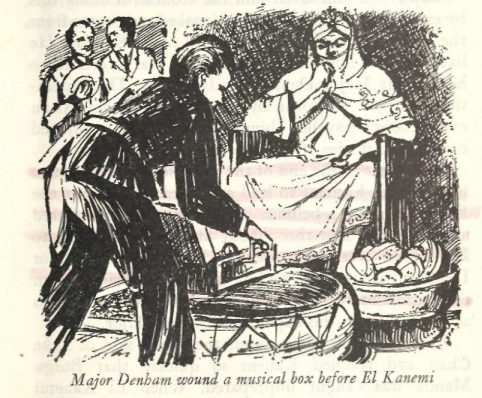
J.R. Milsome's biography of Muhammad al-Amin al-Kanemi, El-Kanemi: the Savior of Bornu, was written for children within the first decade of Nigerian independence. Keeping those two facts in mind, it can excuse this biography somewhat. After all, would Muhammad al-Amin al-Kanemi have cared for Borno to be a part of the Nigerian nation? Does it really make any sense to consider him one of the makers of Nigeria? Only in the sense of promoting Nigerian unity after independence does this biography make even a little sense. As a book for children, Milsome was also able to take certain liberties and not cite any sources. Instead, he can create dialogue to add additional dialogue, details, or characterization to the the life of al-Kanemi. 

Unfortunately, Milsome gets some of the facts wrong and this book is far less useful than that of Brenner for a comprehensive biography of al-Kanemi. For instance, Milsome incorrectly labels al-Kanemi's Fazzani mother as a woman from Tripolitania. He also mentions Egypt as one of the places where al-Kanemi studied for years as a child. This could be true, but more reputable sources mention Tripoli. Furthermore, some of the most interesting episodes in al-Kanemi's political career are excluded. His early marriage to a local chief or ruler's daughter in the town he resided in before being called by the Sayfawas to liberate Gazargamo is omitted from this biography. Neither is al-Kanemi's frustrated ambitions to permanently reconquer Kanem or his "troubled" relations with Yusuf Qaramanli and the Fazzani appear. Nor, for that matter, did the tale of the disastrous Mandara expedition appear in Milsome's biography. 

The errors and omissions in this biography are rather shameful. Young adult readers could benefit from a more critical biography that contextualizes the life of al-Kanemi in a period of political and spiritual transformation in West Africa and the realpolitik of statecraft in the Central Sudan. It could also have, perhaps, through the eventual peace between Sokoto and Borno, been used to promote a model of Northern Nigerian coexistence or harmony. Nonetheless, the creative illustrations are a nice touch, even if the depictions of al-Kanemi do not match those found in Denham, Clapperton and Oudney.

5/28/23

Archaeological Research and Njimi


A video on the work of archaeologists such as Carlos Magnavita and others who may have identified the ruins of Njimi, the capital of medieval Kanem (after Manan). We cannot wait for more published results from these excavations. Perhaps it will force us to rethink some of this blog's preconceived notions about Kanem-Borno urbanism before the Borno phase. It can also shed some light on medieval Kanem's relations with regions like Nubia and West Africa. 

5/19/23

Awlad Muhammad Dynasty and Borno?

Habiba Wada's El-Hesnawi's thesis, Fazzan Under the Rule of the Awlad Muhammad: A Study in Political, Economic and Intellectual History is a must for anyone interested in the history of the Fazzan region of Libya. Although focused on the Awlad Muhammad dynasty which dominated the important area of the Central Sahara from c.1500 to 1813, the El-Hesnawi draws on the earlier history of the Fazzan and its importance in trans-Saharan trade. Indeed, the Fazzan is distinct for being one of the earliest regions important in trans-Saharan trade since Antiquity. And the Awlad Muhammad dynasty itself is a testament to the Fazzan's central role as a crossroads of Egypt, the Maghrib and the Sudan. For any deeper understanding of Kanem-Borno in its Saharan and Sudanic context, one must include the Fazzan in the analysis. Based on oral traditions and some of the surviving documents from the Fazzan, Tripoli, Ottoman, and European archives, a glimpse at the Awlad Muhammad becomes feasible.

Most of the thesis focuses on the Awlad Muhammad dynasty's Fazzani context. It's origins began with Muhammad al-Fasi, a sharif who chose to settle in the Fazzan after returning from Mecca. Said to have come from the Maghrib or western Sahara, El-Hesnawi's thesis emphasizes the importance of the Fazzan as a region of settlement and stop on the pilgrimage route for those coming from the West. Murabitun and those of sharif origin were especially welcome for their piety and Islamic scholarship. Muhammad al-Fasi appears to have used that to build a power-base and eventually establish a ruling dynasty that persisted until the 19th century. In some respects, the rise of the Awlad Muhammad mirrors that of the "Istambulawa" of Air in the 1400s. Like the early sultans of Agades, Muhammad al-Fasi was a mediator between conflicting groups in the Fazzan. 

Through their ability to arbitrate and neutralize opposition (or most of it, save the Khurman), the Awlad Muhamamd established a relatively stable dynasty that united most of the Fazzan. According to El-Hesnawi, patronage of the murabitun and those of sharifian origin helped tremendously with buttressing the new order. In addition, certain Arab and regional chiefs were given tax-free status and incorporated into the regime. Like the Sayfawa of Kanem-Borno, land grants and tax-free exemptions were awarded to several murabitun who then served in the administration. The Awlad Muhammad later relied heavily on slave officials, heavy taxation on the commoners, duties on trade, and the region's geography to thrive economically. Indeed, El-Hesnawi cites evidence of past wealth in what are today ruined villages or destitute areas of the Fazzan. Agriculture, however, once thrived in the oases and the Fazzan even exported some crops to other regions like Tripoli. 

In short, the Awlad Muhammad built a stable regime on the foundations of trade, support for the pilgrimage, taxation (often onerous, but perhaps mainly due to unscrupulous officials), and heavy patronage for Islamic scholars. The administration inherited terms of Kanuri origin, but El-Hesnawi suggests the meaning of the terms in practice often differed. In fact, the author suggests the period of direct Kanem rule of the Fazzan was rather brief. Due to political instability among the Sayfawa and then the wars with the Bulala, it is likely that the Banu Nasir dynasty appointed by Kanem became independent very quickly. This dynasty, which perhaps was the origin of the Kanuri titles used by subsequent Fazzani rulers, was proceeded by the Khurmans and a period of political chaos or conflict. 

As for the Fazzan's relations with Borno and the Sayfawa, El-Hesnawi's thesis argues against some of our assumptions. For instance, due to the constant conflicts between the pashas of Tripoli and the Awlad Muhammad, it is possible that the dynasty was not politically aligned with the Sayfawa. The interest of the Sayfawa dynasts in direct ties with Tripoli support this contention. In fact, when an Awlad Muhammad ruler did indeed flee to Borno due to an invasion from Tripoli, he was executed. Ibn Ghalbun and other sources claim Umar b. Idris did this because the Fazzani sultan had blinded his nephews, but Borno's close ties with the rulers of Tripoli would have also been a factor. Indeed, this helps explain why so many Awlad Muhammad rulers fled to Katsina or Agades in the 1500s and 1600s rather than Borno. The Sayfawa, eager to maintain close ties with Tripoli as the northern terminus of trans-Saharan trade (and the origin of European and Mediterranean goods), might have been more often than not on the side of the pashas in Fazzan-Tripoli conflicts. 

Moreover, the Awlad Muhammad rulers, being so close to Kawar, might have preferred Katsina and Agades as sources of refuge and political support due to fears of a Sayfawa expansion. For instance, other scholars suggest part of the reason Idris b. Ali (Idris Alooma) sent an envoy to the Ottoman capital was due to their own territorial interests in the Fazzan. El-Hesnawi, on the other hand, said the mission was partly motivated by the Ottoman official briefly in charge of the Fazzan invading as far as Kawar or Lake Chad. In our opinion, the Awlad Muhammad probably were eager to maintain some distance from Gazargamo to preserve their own autonomy. However, the necessities of trade and the short route between Tripoli and Lake Chad through the Fazzan meant trade, contact, and migration were probably constant. The Awlad Muhammad, as El-Hesnawi indicates, were additionally friendly to all pilgrims passing through their domain. The numerous Sayfawa mais who performed the hajj often passed through the Fazzan, which would have created close ties already strongly based on trade, Islam, and cultural exchanges.

Last but certainly not least, El-Hesnawi cites one tradition suggesting a large-scale movement of people from Kanem into the Fazzan during the 1200s.  This could be true, as the Diwan indicates that mai Arku established colonies of slaves in Kawar during the 11th century. It is not inconceivable that the Sayfawa rulers in the 1200s were not pursuing similar colonization policies. Indeed, this might explain part of the strong Kanuri and Sudanic influence in the Fazzan noted in European sources. After all, the Awlad Muhammad princes and rulers were sometimes noted to be brown and "black" and Kanuri and Hausa were widely spoken in Murzuq and other parts of the area. This cannot be solely due to the large-scale slave trade that persisted for several centuries. The importance of "black" qadis, settlers, traders, pilgrims, and princes passing through or living in the Fazzan must have contributed to the "Sudanic" character noted by European or Ottoman travelers. After all, even the capital of Murzuq used Kanuri words to designate parts of the city and the people sang songs in the "Sudanic" style rather than that of the Maghrib. The Fazzan of the Awlad Muhammad was, like that of previous Fazzan polities, profoundly shaped by the Central Sudan and a testament to the Sahara as a bridge rather than barrier. If only we could trace this earlier in the period of the Garamantes and uncover more sources on Fazzan's links with Lake Chad.
3/23/23

Bahrey and the Oromo

Although the writings of Bahrey are sadly too brief for a deeper history of the Oromo peoples of the 16th century, his History of the Galla is a fascinating document. As an early ethnographic document of sorts, the Ethiopian monk sought to elucidate the social structure of the Oromo and its role in their often victorious raids and battles with Solomonic Ethiopia. Furthermore, in spite of his own Christian biases and panegyrical allusions to Sarsa Dengel's military prowess and zeal for Christian expansion, Bahrey strikes the modern reader as a relatively balanced source on the Oromo. He blames the small size of the Ethiopian warrior class and the egalitarian (or relatively so) Oromo social system in which all men are reared for war. 

If true, this meant the Oromo age-grade system and their lubas were able to expand and raid several parts of the Solomonic kingdom due to their large source of warriors. Their social system also, according to the end of Bahrey's brief account, included a division of labor on the behalf of the village or community. Their system, though lacking the kind of permanent centralized authority of the Abyssinians or the later Oromo kingdoms, was flexible and able to adapt to different conditions. For instance, the adoption of horses and mules under Mesle in the years 1554-1662 represented an innovation in Oromo military tactics. Thus, it is less surprising to understand how and why the Oromo migrations of the 16th century were so successful, despite occasional internal disputes or divisions. 

The success of the Oromo and the Solomonic dynasty's struggles to contain them during the 16th century remind us of other African states facing similar problems during the same era. The infamous "Jagas" of Kongo, for instance, appear to have formed effective warbands that allowed them to threaten Kongo and other kingdoms in West Central Africa. The Songhai, in West Africa, had Fulani marauders and other issues. Borno, under the Sayfawa dynasty, was also dealing with ongoing rebellions or insecurity near Lake Chad. According to Ahmad b. Furtu, whose chronicles of Idris b. Ali's military campaigns in Kanem and Borno have survived for posterity, the Sayfawa mais had to deal with the rebellious Bulala in Kanem, Tuareg incursions, Kano raids, and attacks from Sao populations near the imperial capital. Like Sarsa Dengel, Idris b. Ali appears to have been quite effective as a military leader. The displaced populations, war captives, and nearly exterminated peoples who felt the wrath of Borno were, for the most part, pacified or reduced to tributary status. 

Unlike the Solomonic rulers, Borno appears to have been far more effective at securing its internal borders by the late 16th century. Part of this must have been due to the different socioeconomic structures of their respective enemies, as well as internal factors like military tactics, adoption of firearms, and administrative practices. One wonders what the Sayfawa would have done if faced with an enemy comparable to the Oromo peoples of the 16th century. The closest enemy might have been the Tuareg along the northwestern border and some of the Tubu and Arab populations in Kanem who were initially aligned with the Bulala sultans. We know Idris b. Ali, at least, won over some of the latter two groups and was able to force some of the Tuareg raiders into vassal status.

3/22/23

Meroitic Lower Nubia

Millet's dissertation, "Meroitic Nubia," was not what we expected. Instead of a speculative and dated interpretation of Meroitic Lower Nubia and the Dodekaschoinos, Millet's essay focuses on interpreting the Meroitic inscriptions and texts to make sense of northern Nubia's elite administrative, religious, and kinship structures. Due to our failure to make sense of most of the Meroitic language, however, there is a lot of guesswork and attempts to corroborate guesses with Demotic and Greek sources or texts. With those limitations in mind, Millet nonetheless raises a number of interesting questions about the role of northern Nubia during the 3rd century of our era. 

According to Millet, the region's growing importance must have been linked to the adoption of the waterwheel, gold mining at Wadi el-Allaqi, and trade routes through the desert to Egypt. Intriguingly, Millet also proposes that Lower Nubia's economic importance was also based on trade with the west and southwest, with Darfur and Kordofan. The spread of the camel and Meroe's interests in peace with the desert nomads (ancestors of the Beja and others) must have been, in part, motivated by a desire to provide security for trade routes to Egypt. Although Meroe appears to have "shared" the Dodekaschoinos with the Ptolemaic and Roman rulers of Egypt, the continued importance of the temple at Philae represented another interest of Meroites in Lower Nubia. 

As for the general thrust of his thesis, on collateral inheritance of titles in Meroitic Nubia or the degree to which his tentative genealogies of elite families in the region can be substantiated, we assume more recent scholarship has partly addressed this. Our friends, the Wayekiye family, for instance, must be one of the fascinating families for analysis because of their education and links to the princely Akin lineage. Were they and other similar families also investing in land, and exploiting tenant farmers? Furthermore, it would be interesting to see if the relationship of Meroitic Lower Nubia to the heartland of the state was comparable to Lower Nubia's relation to Dongola in the medieval era. Certainly, the survival of Meroitic culture to some extent and a framework assuming cultural continuity would suggest this. 

3/20/23

Medieval Nubia's Social and Economic History

Giovanni Ruffini's ambitiously titled Medieval Nubia: A Social and Economic History asserts a number of compelling and, despite its limited sources, plausible theories for Christian Nubia. Instead of seeing Makuria or Dotawo as lacking private land tenure or a monetized economy, Ruffini draws from the Qasr Ibrim land sales and letters to argue Makuria was a mixture of classical Mediterranean and local Sudanese traditions. Like Spaulding and others who have analyzed various aspects of Nubia's vast history, Ruffini argues for cultural continuity as a guiding theme for making sense of Nubia. Numerous examples are cited in the text of Meroitic and even pharaonic Egyptian influences in medieval Nubian religion, culture, and customs. The Choiak public festival, for instance, was likely of Osirian origin and survived in Coptic and Nubian Christian practice. Nubian rituals of today that include dipping new-born infants into the Nile and referencing Mary likely date from the Christian period, too. 

Thus, from the late Meroitic or Late Antique era until about 1821, one can arguably find much continuity across the political dimensions of the region. This can be highlighted with the adoption of the waterwheel and the role of the Nile and local ecology in both Lower and Upper Nubia. However, Nubia was, through thousands of years of contact with Egypt and the Mediterranean world, also a recipient of those influences. That impact can be seen in the Greco-Roman and Coptic traces in medieval Nubia's legal traditions. Naturally, then, one cannot be surprised to find similarities between Old Nubian land documents and those in Coptic in Egypt. Moreover, the importance of Greek as a living and even divine language used for bilingual Biblical texts, titles, amulets, and rituals attests to the survival of Roman and Byzantine influences long after Egypt fell under Muslim rule. Ruffini's Medieval Nubia attempts to demonstrate this signifiance of the classical Mediterranean's legacy through Qasr Ibrim's surviving documents, plus occasional epigraphic, ethnographic, literary, archaeological, and additional sources.

Unfortunately, our limited sources leads one to think Ruffini's study remains too speculative. While likely correct about the existence of private land tenure in Lower Nubia (and throughout Nubia, probably), much of the analysis of the Qasr Ibrim documents relies on speculation. We await further confirmation from Dongola, Soba, and other sites to ascertain the degree to which some of these speculative conclusions can be borne out. Nonetheless, Ruffini's analysis is persuasive based on the assumption of cultural continuity and the comparative data from other parts of Sudan and Egypt. The implications of this suggest a much wider territory included within what is usually considered "Mediterranean." In addition, it suggests medieval Nubia's land was productive or profitable and that elites who engaged in land sales were socially linked to the ecclesiastical and royal authorities. This elite group, whose conspicuous consumption through feasting accompanied land sales, also appears in the external Arabic sources in occasional revolts, conflicts with Nubian kings, and relations with Egypt. Alas, we are still left in the dark about the slaves, peasants, tenant farmers, and other groups in this complex society. 

The internal sources also call into question some of the problematic assumptions made by Western scholars who heavily rely on the external textual references. Some, like al-Masudi definitely reflect what might be considered a racial bias, although perhaps Ruffini overstates the case in regards to medieval Arab views of black Africans. Regardless, medieval Nubia represents a case in which one must carefully use the medieval Arabic sources when analyzing societies of the Sudan. Without understanding local dynamics, local sources, and the literary topos of the outside writers, one can perpetuate biases and omissions from the original writers, such as al-Masudi. Unfortunately, we have a lot more to uncover from Old Nubian sources and archaeological research before we can confirm some of Ruffini's conclusions. Research on Alwa would be particularly interesting here, since the external sources suggest it was wealthier than Makuria. Alwa's southern location and less reliance on the Nile also raises interesting questions about the periods of unification of medieval Nubia and Alwa's relations with societies further east and west. Either way, the future of Nubiology promises to be exciting.