Les pays du Tchad et la montée des périls, 1795-1850 is another one of Zeltner's shorter books, this one consisting of some introductory chapters and essays on 4 major figures who shaped the Chad Basin in the first half of the 19th century. Beginning with 2 chapters on the regional context and Arab migrations before delving into Abd al-Jalil, Yusuf Caramanli, Muhammad al-Amin al-Kanemi and Sabun of Wadai, Zeltner treads familiar ground. Those who have read his work on Tripoli and Kanem will perhaps not find much new material here. Nonetheless, he corrects some of his past assertions or mistakes and offers some more detailed analysis and commentary on Arab genealogies and the rise of Wadai as the major power in the eastern Chad Basin. Zeltner is probaby correct to identify the ancestors of the Bani Hassan as among the Arabs in Kanem who allied themselves with Idris b. Ali against the Bulala in the 16th century. The suggestive analysis of Kotoko and Mandara state and religious ideologies and the ancestor-snake cult of Wadai are thought-provoking, too.
Although one may take issue with a great man approach to the history of the area around Lake Chad, Zeltner's detailed study of the 4 aforementioned leaders actually does a great job highlighting how closely connected their respective states and peoples were. For al-Kanemi, the shehu who founded today's dynasty of Borno, his maternal family's Fezzani origins and his upbringing in today's Libya (plus his several years spent in the East) illustrates how the elites of Borno were not isolated from broader trends and currents in the Islamic world. Moreover, due to what Zeltner sees as the military weakness of Borno, al-Kanemi had to rely on diplomacy to avert a Tripolitanian invasion and use their support against Bagirmi. While he perhaps ultimately failed to fully restore Kanem to Bornoan suzerainty, and the Fezzani invasions were disasters that even included his sister among their victims, al-Kanemi succeeded in impressing the British Borno mission, ending the Bagirmi threat, defended the western frontier, and secured an alliance with the Awlad Sulayman.
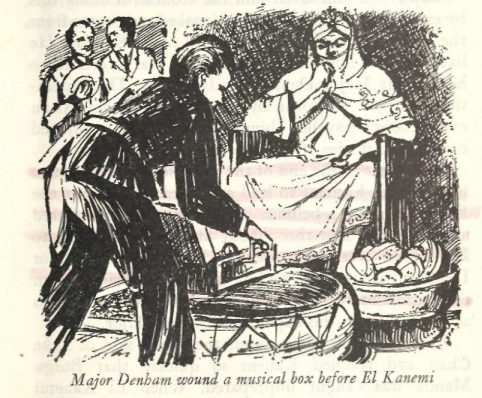
One cannot help but admire al-Kanemi, despite his flaws and perhaps his questionable reasons for agreeing to send his child as a hostage to Libya. His charisma, ability to attract Kanembu and Arab followers (as well as other adventurers and outsiders), military and spiritual leadership and interest in technological and economic advantages of relations with the British certainly made him an exceptional ruler in a turbulent era. It just seems fantastic that he was so afraid of a Tripolitanian invasion despite surely knowing something of the financial straits of the Pasha. Either way, British refusal to loan the necessary funds and direct relations with Britain made the invasion impossible. That must be part of the reason for al-Kanemi's cordial reception of Denham, Clapperton and Oudney. He further secured Borno from northern attacks through sealing an alliance with Abd al-Jalil and the Awlad Sulayman, who became the effective rulers of the Fezzan after al-Mukni's fall from grace.
The other figures examined by Zeltner include some of the most influential and notorious figures in the history of Chad and Libya. Yusuf Caramanli, the murderous man who slaughtered his own brother in front of their mother, saw to the end of the Awlad Muhammad dynasty in the Fezzan. His corsair activity and heavy involvement in the slave trade were interrupted by European pressure and the Greek war of independence, forcing him to overtax the population. Unlike, say, Muhammad Ali in Egypt, he was never able to successfully conquer or launch a permanent occupation of Sudanic Africa. His bey of the Fezzan, who harbored his own hopes of an empire in the southern lands, was recalled. As mentioned previously, Yusuf additionally failed to secure the necessary British loans to fund a full invasion of Borno. Nevertheless, the fact that his troops were able to invade Bagirmi and loot Massenya was an impressive feat, showing Tripolitanian imperial ambition perhaps akin to that of Egypt in the Sudan. It also attests to the powerful role of firearms in a region which had once been a pioneer in the use of muskets in 16th century Borno.
Wadai under Sabun and Abd al-Jalil of the Awlad Sulayman represent more admirable figures. The latter, after his tribe's defeats and oppression from Yusuf Caramanli and Tripolitanian authorities, almost became the force of unification for Libya's Arabs. By mastering the Fezzan and establishing cordial relations with Borno, he only needed to secure a Mediterranean port. The divisions within the Arab population and conflict with the Pasha who succeeded Yusuf made this impossible before his death. Tragically, a famine and treason among the Arab allies brought about the death of Abd al-Jalil. The Awlad Sulayman later migrated to Kanem, where they became the major arbiter between Borno and Wadai. British and French involvement in Tripolitanian affairs, plus British interest in securing a sea port open to Fezzani caravans (and a dream of ending the slave trade) further demonstrate how significant European involvement in Central Sudanic, Central Saharan affairs were before the colonial conquest.
Wadai under Sabun, who restored centralized monarchical power and opened a trade route through Benghazi, represented another visionary leader whose successors arguably failed to live up to the opportunities he created. Although we recall other sources mentioning Wadai's invasion of Bagirmi under Sabun as an action mandated by the Sayfawa mai in Borno, Zeltner focuses on the invasion and subsequent tributary status of Bagirmi as a momentous event and display of the regional ambitions of Sabun. Wadai benefited from Barma and other migrants and slaves who brought with them their weaving and dyeing skills. Moreover, intervention in the affairs of Kanem by investing their own alifa at Mao represented a direct threat to Borno. Despite Sabun's opening of a direct trans-Saharan route to the Mediterranean (instead of going through the Fezzan or the arduous route through Darfur, a state previously at war with Wadai) and his success in reducing Bagirmi to a vassal, his successors closed the kingdom due to fears of a Tripolitanian invasion. It would take decades before Wadai's rulers took full advantage of the commercial opportunities Sabun created. Fortunately for Wadai, their rulers did succeed and in so doing created a state which approximated the borders of modern Chad.
Unquestionably, the first half of the 19th century brought major changes to the Central Sudan and Libya. Demographic changes with the further migration of Arab nomads south of Lake Chad accompanied political and economic transformations. The slave trade, still of the utmost importance for trans-Saharan commerce, continued unabated. But the growing influence of the British and the French in Tripoli and direct contact with Borno promised significant alterations in the balance of power. Borno emerged from the jihad to the west as reduced power, no longer a hegemonic force. Wadai to the east became a major force to reckon with. Libya, through the fall of the Caramanlis and Awlad Sulayman, was more effectively administered by Ottoman-appointed officials. While British dreams of ending the slave trade and ensuring commerce with the African interior via the Sahara did not materialize, the looming threat of Europe dangled like a sword of Damocles over this region of Africa.